
Investigative Report Exposes Imposter Accounts Spreading Houthi Propaganda
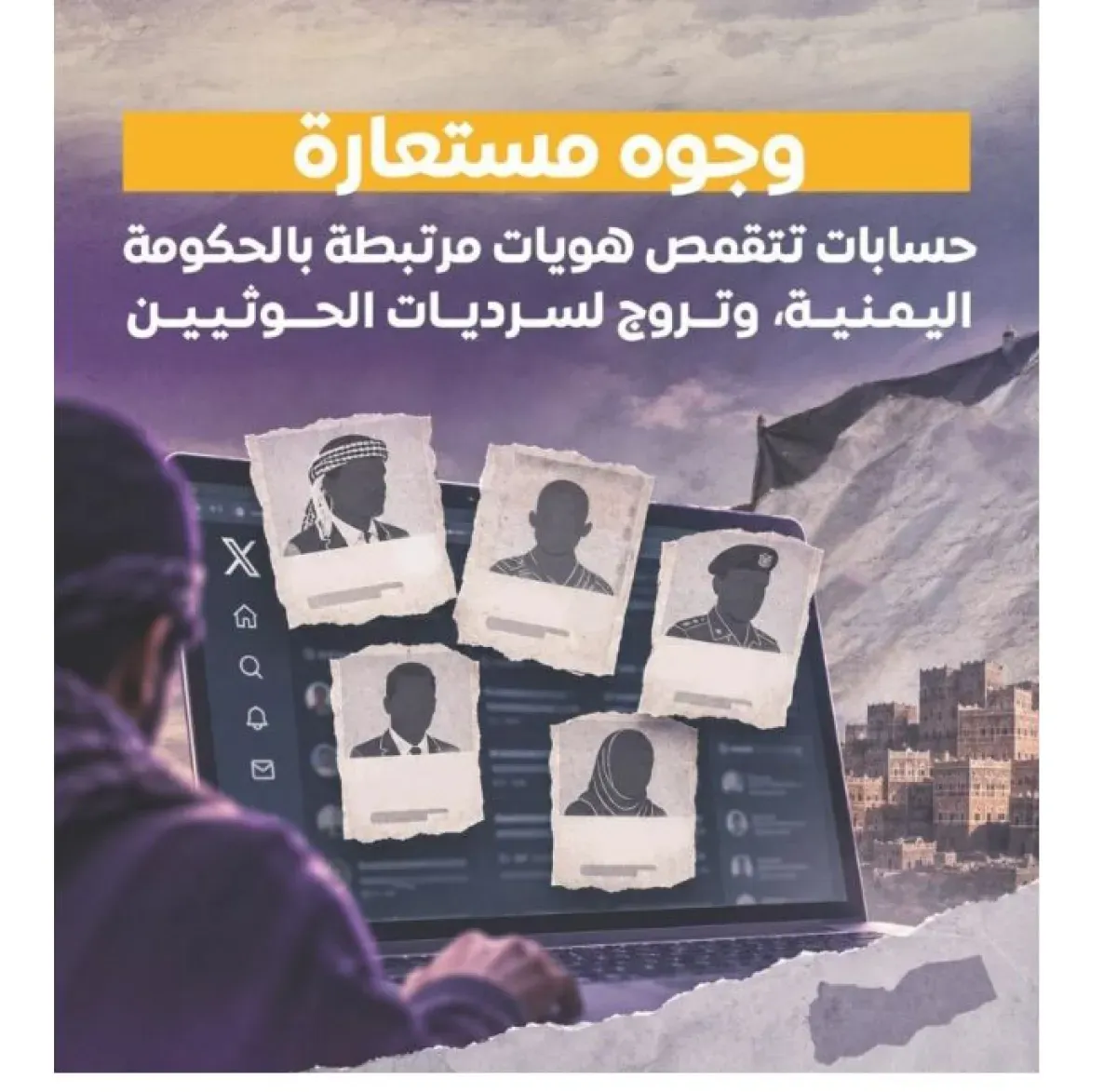
An investigative report has uncovered the existence of fake accounts on the X platform impersonating Yemeni political, military, religious, and tribal figures. These accounts, posing as supporters of the legitimate government or anti-Houthi forces, are disseminating narratives and stances that align with Houthi propaganda, aiming to erode trust in the government, army, and opposition groups.
The investigation, published by the Yemeni platform "Sadaq" under the title "Disguised Faces," examined a sample of 15 X accounts. It documented instances of impersonation of well-known Yemeni personalities, alongside suspicious accounts whose published content contradicts the identities they claim to represent, particularly concerning praise for the Houthis and the promotion of their political and military narratives.
Among the documented cases are accounts impersonating Ibrahim Al-Hamdi, son of the former Yemeni President; Wadad Al-Baid, daughter of the former Southern President Ali Salem Al-Baid; and Asia Abdul Fattah Ismail, daughter of former Southern President Abdul Fattah Ismail. The report also identified impersonation of preacher Wael Abadi and military leader Major General Yousef Al-Sharaaji, as well as accounts assuming southern, tribal, and military identities.
One X account, using the name and picture of Nashwan Ibrahim Al-Hamdi, presented itself as his spokesperson, publishing political positions attacking Saudi Arabia and Yemeni figures while defending Houthi rule in Sana'a. Al-Hamdi later denied owning any account on the platform, stating that any accounts published in his name do not represent him. Some of this account's posts garnered hundreds of thousands of views, being circulated as genuine statements, highlighting the effectiveness of impersonating nationally symbolic figures to lend false credibility to propaganda messages.
Similarly, an account named "Wadad Al-Baid," presented as a daughter of the late President Ali Salem Al-Baid, promoted content that was subsequently reported by media outlets. However, Hani Al-Baid, another son of the former president, denied having a daughter by that name, confirming the account's fraudulent nature and lack of connection to the family. The investigation also documented an account impersonating Asia Abdul Fattah Ismail, who officially denied owning any accounts in her name and warned against circulating content attributed to her, despite the account publishing pro-Houthi positions and military operations.
The report further detailed accounts impersonating preacher Sheikh Wael Abadi, using his identity and image to spread political and security news related to Marib province. Abadi later released video statements denying his ownership of any X accounts and disavowing the attributed posts. Another documented case involved an account impersonating Major General Yousef Al-Sharaaji, Deputy Chief of Joint Operations, which spread claims of dissent and rebellion within government forces, along with fabricated news of his resignation and the withdrawal of southern forces from frontlines. Al-Sharaaji refuted these claims, asserting that accounts using his name and rank are fake and that he does not possess an X account.
Some accounts employ a more deceptive tactic, using tribal, military, or southern identities while professing support for the government or the southern cause. Their primary activity involves attacking government forces, questioning their performance, praising Houthi military capabilities, and promoting Houthi rhetoric. Examples include accounts claiming to represent citizens from Marib or soldiers from the "Shield of the Homeland" forces, and an account named "Tahania Al-Radafani," identifying as a southern human rights activist and journalist, which the investigation revealed had previously used the name of southern leader Fadi Baoum, who has also warned against impersonation.
The investigation acknowledges that the available evidence does not permit a definitive conclusion that all these accounts are managed by a single central entity or that every account criticizing the Yemeni government is linked to the Houthis. It emphasizes the need to distinguish between confirmed cases of identity theft, fabricated personas, and accounts that raise suspicion due to content contradictions. The report references international and Yemeni studies on the evolution of the Houthi digital media apparatus, including a 2024 study by the Institute for Strategic Dialogue (ISD) that identified 98 digital entities linked to or supporting the group, 41 of which were X accounts, alongside research from the Sana'a Center for Strategic Studies and the Yemeni Center for Policy.
The observed pattern involves exploiting identities with social or political credibility within anti-Houthi circles to disseminate messages aimed at undermining trust in government institutions and the army, portraying the Houthis as stronger and more organized, and ultimately guiding public opinion towards conclusions that benefit the group without necessarily originating from overtly declared propaganda accounts. The report notes that some accounts interact by reposting, commenting, and mutually promoting each other, and that Houthi-affiliated media outlets have republished content from several impersonating accounts, amplifying the reach of narratives falsely attributed to well-known Yemeni figures.
This method extends beyond personal accounts to include the creation of news pages and platforms bearing the names of Yemeni government-controlled governorates and regions. These platforms disseminate content adopting Houthi narratives, leveraging their local-sounding names to attract followers and lend credibility to their publications. The investigation concludes that the most significant danger lies not in openly declared Houthi propaganda accounts, but in those that conceal themselves behind the names and personas of the group's adversaries, exploiting the trust associated with these identities to disseminate disinformation, influence public opinion, and sow division among anti-Houthi forces and components.
Addressing this form of disinformation requires verifying the official accounts of public figures and military leaders, refraining from treating attributed posts as accurate without confirmation from authorized sources, and enhancing capabilities for monitoring and verifying organized digital campaigns.